


Your teenager comes home, says two words, and disappears into their room. The door stays shut until dinner. Dinner is quiet. Maybe it’s been three weeks. Maybe it’s been three months, and you’ve been telling yourself it’s a phase for most of them.
Here’s the part most guides leave out: you don’t need to be certain your teen is depressed before you do something about it. Knowing how to help a teenager with depression starts with one conversation, not a diagnosis. What actually moves the needle is simpler and harder than a checklist – staying in the room with them, knowing when to bring in a clinician, and understanding what treatment really involves.
We’re a Brooklyn psychotherapy practice. We see kids from age 5 through adulthood, and our founder started her career working with adolescents. This is close to what we’d tell you if you called today.
In short: what actually helps a depressed teenager
- Talk first, and keep talking. One conversation rarely changes anything. The fifth one often does.
- Watch the pattern, not the mood. Two weeks or more of irritability, withdrawal, or lost interest is the signal – not one bad Sunday.
- Ask directly about self-harm. If the answer is yes, that’s a today problem, not a this-month problem.
- Therapy works. The American Academy of Child and Adolescent Psychiatry (AACAP) names cognitive behavioral therapy (CBT) and interpersonal psychotherapy (IPT) as forms of therapy shown to be effective for depression in children and teens.
- Do the unglamorous things. Sleep, food, movement, daylight, and one trusted adult outside the family.
- Don’t wait for “bad enough.” An evaluation is information. It’s not a commitment to years of anything.
Two numbers are worth carrying with you. AACAP’s parent guidance says more than one in seven teens experiences depression each year. And in the CDC’s 2023 Youth Risk Behavior Survey, 39.7% of U.S. high school students – roughly four in ten – reported persistent sadness or hopelessness. Your kid is not the only one in their hallway going through this, even if it feels that way at your kitchen table.
Signs of depression in teens that parents miss
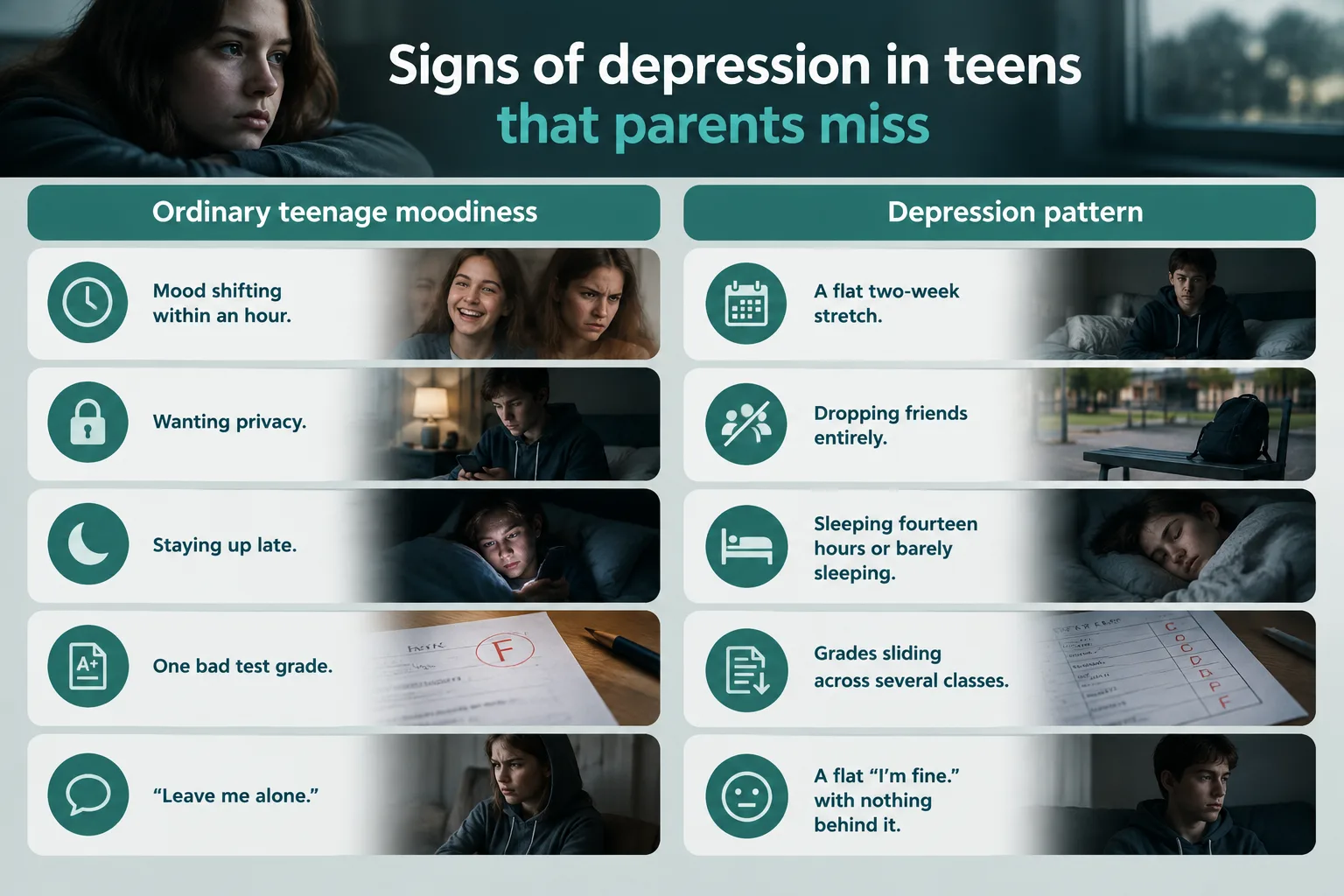
The single most missed sign is anger. In teenagers, depression often looks like a short fuse rather than tears: slammed doors, sarcasm, snapping at the person who asks if they ate. Parent guides and pediatric hospitals that write about teen depression make the same point – irritability and agitation can be the loudest symptom, and sadness can be almost invisible.
The signs of depression in teens that parents most often explain away:
- The friend drop. Not fewer plans, but no plans. They stop answering the group chat and quit the thing they loved in eighth grade.
- The school slide. Grades slipping across several classes, missing assignments, morning stomachaches that clear up by 10 a.m.
- Sleep that’s off in both directions. Up until 3 a.m. on their phone, or sleeping fourteen hours and still wrecked.
- Appetite changes. Skipping meals, or eating far more than usual, without a growth spurt to explain it.
- Physical complaints. Headaches and stomach aches that get checked out and come back normal. AACAP notes depressed children often report more of these.
- A flat “I’m fine.” Not defensive – empty. Nothing behind it.
- Self-criticism that sounds like fact. “I’m stupid.” “Everyone would be better off.” Said casually, repeated.
- Substance use. AACAP notes teens may use alcohol or other drugs to try to feel better.
Moodiness moves. A teenager slams a door and an hour later wants pizza. Depression stays flat: two weeks or more of most days looking like the same gray weather, with school, friends, sleep, and appetite all drifting at once. NIMH’s guidance to teens puts it plainly – sad most of the time for a few weeks or longer, plus trouble concentrating or enjoying what they used to, is a reason to talk to an adult about depression.
What to say in the first conversation (and what to avoid)
Most advice on what to say to a depressed teenager stops at “listen and validate,” which is useless at the moment your kid says “I’m fine” and closes the door. Here are words you can actually use.
Pick a side-by-side setting. Cars, walks, washing dishes, shooting hoops. Face-to-face at the kitchen table feels like a hearing.
Open with what you observed, not what you concluded. “I’ve noticed you’ve been in your room most nights since practice ended, and you haven’t mentioned Maya in weeks. I’m not mad at you. I’m worried, and I want to understand.”
Then stop talking. Count to ten. The silence is doing the work.
Ask directly about suicide. AACAP advises parents to ask their child how they’re feeling and whether anything is bothering them, because some kids will say they want to hurt themselves when asked and won’t volunteer it. So ask: “Are you having thoughts of hurting yourself or of not wanting to be here?” Ask it plainly, without a gasp. A direct question opens a door; it doesn’t put ideas in anyone’s head.
Name what you can offer. “I’d like to find you someone to talk to who isn’t me. You can help pick who.” Ownership matters to a 15-year-old.
What tends to shut the conversation down:
- “You have nothing to be sad about.” Translation: your feelings are wrong.
- Fixing in the first ten minutes. Advice lands after they feel heard, not before.
- “When I was your age…”
- A lecture about screen time in the same breath as a mental health check-in. Different conversation, different day.
- Promising secrecy you can’t keep. Say instead: “If you tell me you’re in danger, I’m going to act on that. Everything else stays between us.”
Expect a bad first attempt. Most teens test whether you can handle it before they tell you anything real. Come back the next day: “I’ve been thinking about what you said. No agenda. Just checking in.”
When it is more than teenage moodiness: signs your teenager needs therapy
The clearest signs your teenager needs therapy are about function and safety, not vocabulary. Consider an evaluation if you’re seeing:
- Two weeks or more of most days with low mood or irritability.
- School falling apart – refusal, failing grades, skipped classes.
- Loss of interest in nearly everything that used to matter.
- Any talk of suicide, self-harm, or being a burden, whether or not it sounds serious.
- Self-harm marks, or a sudden shift to risky behavior.
- Panic, constant physical complaints, or a level of anxiety that shrinks their world.
- Drinking or drug use.
- A family that has started tiptoeing. If everyone is managing one person’s mood, the system is already struggling.
You don’t have to clear this bar to call. “Not bad enough” is not a clinical category, and an assessment is the cheapest way to find out where you actually stand. If you’re trying to sort out whether what you’re seeing is depression or something else, this overview of signs you need depression therapy walks through the same questions.
If your teen is in crisis right now, stop reading and act.
- Call or text 988 – the Suicide & Crisis Lifeline is free, confidential, and available 24/7/365.
- Text HOME to 741741 to reach the Crisis Text Line.
- If they are in immediate physical danger, call 911 or take them to the nearest emergency room. Do not leave them alone.
What treatment for teen depression looks like
Parents often arrive at the teenage depression and treatment question expecting one answer. There isn’t one, but there is a sequence, and it’s less mysterious than it sounds.
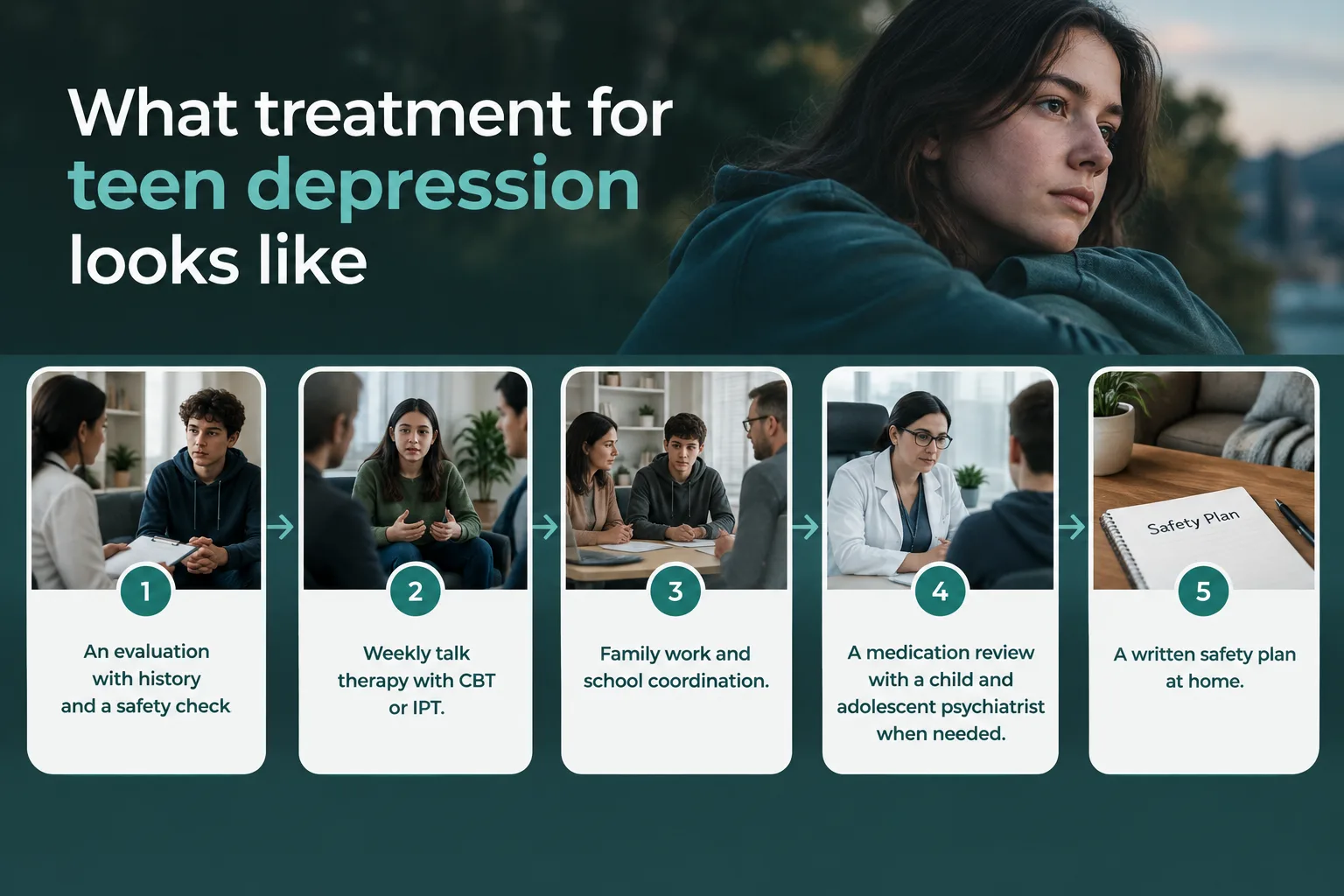
First, an evaluation. A clinician takes a history – when this started, what’s changed, sleep, school, friends, family history, anything that’s happened in the last year – and asks your teen directly about safety. You’ll likely fill out a screening questionnaire. Nobody expects a diagnosis in the first hour.
Then, talk therapy. AACAP points to CBT and IPT as effective for teen depression. CBT works on the loop between thoughts, feelings, and what a teenager actually does all day; IPT works on relationships and role changes, which is where a lot of adolescent depression lives. Sessions are usually weekly at the start. Family work is often part of the plan, because a teenager’s environment is not optional to their recovery, and school coordination sometimes is too.
Medication, when it’s on the table. For moderate to severe depression, or when therapy alone isn’t enough, a child and adolescent psychiatrist may discuss an antidepressant alongside therapy. AACAP is straightforward that the risks and benefits of any medication should be carefully discussed before starting. That conversation belongs with a prescriber who treats adolescents – not with a forum thread at midnight.
Safety at home, planned on purpose. Part of good care is a plan for the bad nights: who your teen calls, where medications and firearms are stored, what the warning signs are, and which adult is on duty. Ask for that plan.
What progress looks like isn’t a permanently cheerful teenager. It’s function coming back first – sleeping, eating, showing up, seeing one friend – with mood following. If a clinician promises a fixed number of weeks, ask sharper questions.
If you want the fuller picture of how depression treatment is structured at our practice, our Brooklyn depression therapy page covers the clinical side, including work with teens and young adults.
When anxiety comes with it
Depression in teenagers rarely travels alone. Anxiety is the most common companion – and it’s often what parents notice first, because anxiety is loud: the stomachaches before school, the “what if” spiral at 11 p.m., the reassurance-seeking that never quite lands, the party they begged to skip.
Knowing how to help a teenager with anxiety follows the same spine as depression: name what you see, don’t argue with the feeling, and don’t organize the family around avoidance. Every time a feared thing gets avoided, the fear gets a little more believable. So the goal is small steps toward the thing, not a rescue from it – one text to a friend, one class attended, one party shown up to for twenty minutes.
What helps alongside treatment:
- Sleep and caffeine, honestly audited. A teen running on five hours and two energy drinks will read as anxious.
- Fewer reassurance loops. Answer once, kindly, then redirect.
- Movement, ideally outside, ideally with you.
- A named adult at school who knows what’s going on.
Depression, anxiety, and ADHD overlap heavily in adolescence, and untreated ADHD can look like a mood problem – the failing grades and the shutdown often start with executive function, not sadness. If focus and follow-through have been the issue since elementary school, it’s worth reading about ADHD therapy in Brooklyn before assuming this is depression alone.
Getting a Brooklyn teen into therapy: in person, online, and what it costs
Geography matters more than national guides admit. A weekly appointment your kid will actually attend beats a better-regarded practice two boroughs away.
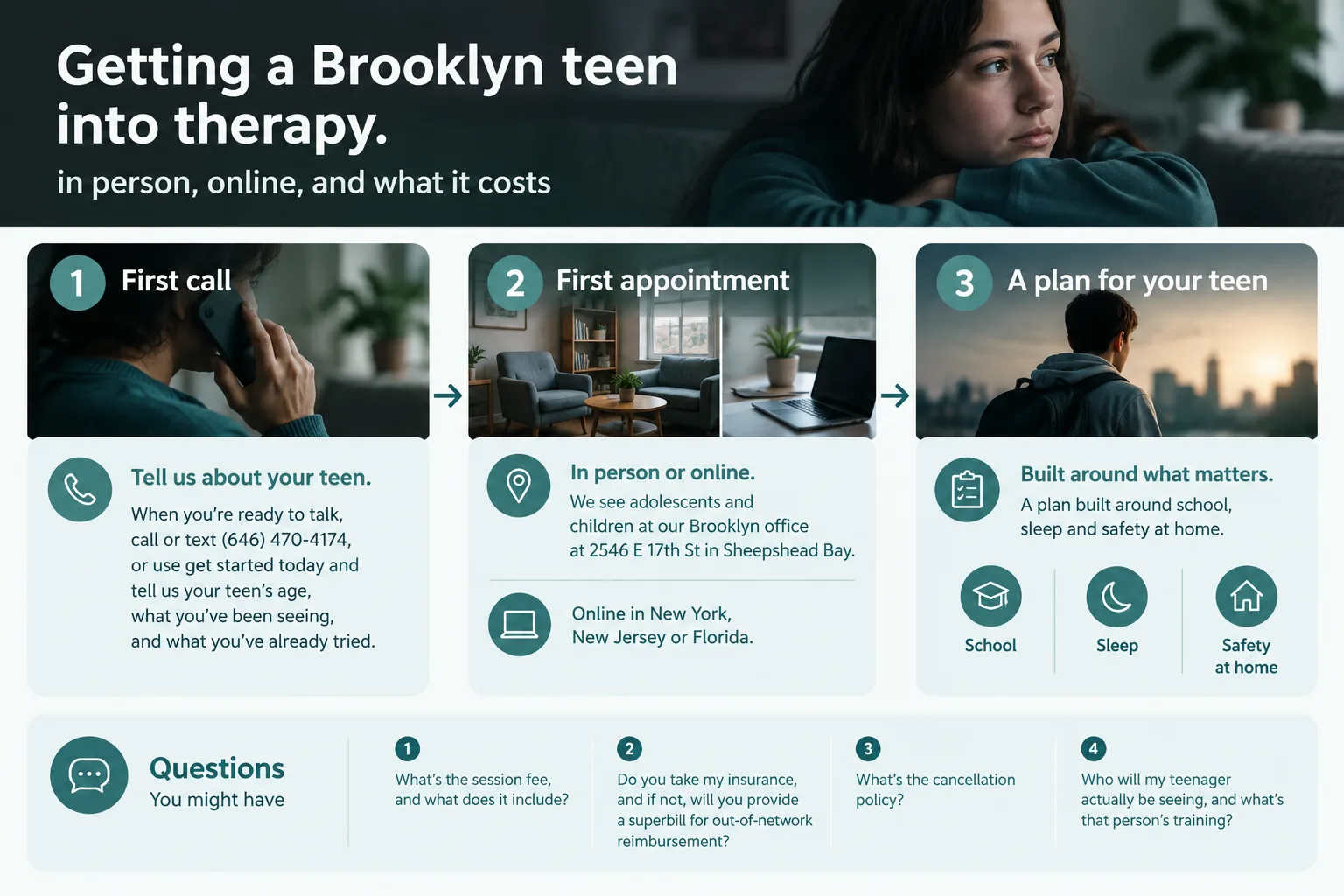
We see adolescents and children at our Brooklyn office at 2546 E 17th St in Sheepshead Bay. There’s a playroom for younger kids, and the office is set up for teenagers who’d rather not sit knee-to-knee with a parent in a waiting room. In-person therapy works well for teens who need the separation from home – the appointment is a place, and going there is part of the point. If you want to see how the space and the practice are set up, start with in-person therapy in Brooklyn.
Online is a real option, not a downgrade. We offer telehealth for families across New York, and multi-state online therapy for clients in New Jersey and Florida. Some teenagers talk more freely from their own room than they ever will in an office. Others need to physically leave the house. You know your kid; pick accordingly.
On cost, here’s the honest version: what you pay depends on the type of session, whether you’re using insurance or paying privately, and whether you have out-of-network benefits to claim back. Fees for therapy in this city vary widely by license, specialty, and setting, and any practice quoting you a number before knowing your plan is guessing. Ask four things on the first call:
- What’s the session fee, and what does it include?
- Do you take my insurance, and if not, will you provide a superbill for out-of-network reimbursement?
- What’s the cancellation policy?
- Who will my teenager actually be seeing, and what’s that person’s training?
For a wider look at how therapy costs work in this borough, our breakdown of how much therapy costs in Brooklyn covers the variables without the sticker shock. When you’re ready to talk, you can call or text (646) 470-4174, or use get started today and tell us your teen’s age, what you’ve been seeing, and what you’ve already tried. That’s enough to begin.
Questions parents ask
Why is my 15 year old so depressed?
Usually there’s no single cause, and that’s normal. AACAP’s guidance for families is blunt about it: sometimes depression seems to come out of nowhere, other times it follows stress or a loss, and bullying and heavy social media use may be associated with it. Depression also runs in families, and having ADHD, anxiety, or a learning difference raises the risk.
The more useful question is not why but what now. Ask your teen directly how they’ve been feeling, get an evaluation if the pattern has lasted two weeks or more, and treat the cause-hunt as something that happens alongside care, not before it.
What if my teen refuses therapy?
Very common, and rarely permanent. Don’t turn it into a power struggle you’ll both lose.
Try offering a choice instead of an order: “You pick. I have three names. You can talk to one of them, or we can start with your pediatrician.” Ask for one session, not a commitment: “You don’t have to want to go. You just have to come once, and then tell me what you thought.” Sometimes the first appointment is for you, so a clinician can help you plan the next move. And if safety is on the line, refusal doesn’t get a vote – you act.
How do I help my teenage daughter with depression?
The fundamentals don’t change: observe out loud, ask directly, watch function, get help early. What’s worth extra attention with girls is the self-talk. Depression in teenage girls often arrives dressed as self-criticism about body, grades, or being liked, and it can look like social drama from the outside. Take it seriously rather than calling it drama. Boys, meanwhile, more often show anger and withdrawal, which is easy to read as attitude. Same illness, different costume.
Should I wait and see if it passes?
If it’s been most days for two weeks or more, or if school, sleep, friends, or eating have changed, don’t wait. If there’s any talk of suicide or self-harm, you act today, not next month. Waiting is only reasonable when the mood clearly lifts, the function is intact, and your teen is still doing the things that matter to them.
How long does treatment take?
Longer than a cold, shorter than most parents fear. Care usually starts weekly, and progress gets measured in function – sleeping, attending school, seeing friends – rather than in whether Tuesday was a good day. Some teenagers need a few months; others need longer and a plan that includes school and family. Any clinician who gives you an exact end date in the first session is selling certainty they don’t have.
Sources and further reading
- National Institute of Mental Health, Teen Depression: More Than Just Moodiness
- American Academy of Child and Adolescent Psychiatry, Depression in Children and Teens (Facts for Families No. 4)
- American Academy of Pediatrics, Bright Futures preventive care periodicity schedule (routine adolescent depression screening from age 12)
- CDC, 2023 Youth Risk Behavior Survey results (39.7% of high school students reporting persistent sadness or hopelessness)
- 988 Suicide & Crisis Lifeline – call or text 988, 24/7/365, free and confidential
- Crisis Text Line – text HOME to 741741
Sources checked in November 2026.